8. December 2025

The final location tour of the year for film professionals took place on October 14th and 15th in cooperation with the East Bohemia Film Office. Over the course of two days, we scouted locations including the array of historical vehicles available for filming at the Industrial Museum in Mladějov, the ‘lunar landscape’ near the Hřebeč mining trails, a unique local observatory, a modern art gallery housed in a charming rural villa, the chateaus of Litomyšl and Moravská Třebová, the Jevíčko Sanatorium, and the former factory complex of Oskar Schindler.
As usual, the event was well-attended by experienced producers and location managers, who highly valued the organization of the entire location tour and the specific sites presented. Producer Márcio Venturi singled out the charming 1918 building of the Jevíčko Specialist Treatment Institute as the program’s highlight. He praised the location tour’s exceptional organization: “Everything was perfect, and I would certainly recommend the event to everyone.”
Producer Petr Rauschert also commended the organization. “Unlike pre-filming location scouts, the location tour offers a look at places that are unfamiliar - at least to Prague residents - at a friendly, relaxed, and unhurried pace, featuring a diverse mix of exteriors and interiors.” Rauschert highlighted the former Mladějov fireclay factory complex and the “lunar landscape” in Hřebeč as highly appealing filming locations.
“For shooting intriguing exteriors, the two locations are so close that I consider them one. They provide interesting, and in their own way, unique vistas and through-views of the outdoor spaces,” Rauschert notes. He emphasized the “post-apocalyptic exteriors of the Mladějov complex surrounding the old mining towers, the well-preserved historical small train station with its narrow-gauge railway, and the opportunity to utilize working historical vehicles and locomotives from the local Industrial Museum.”
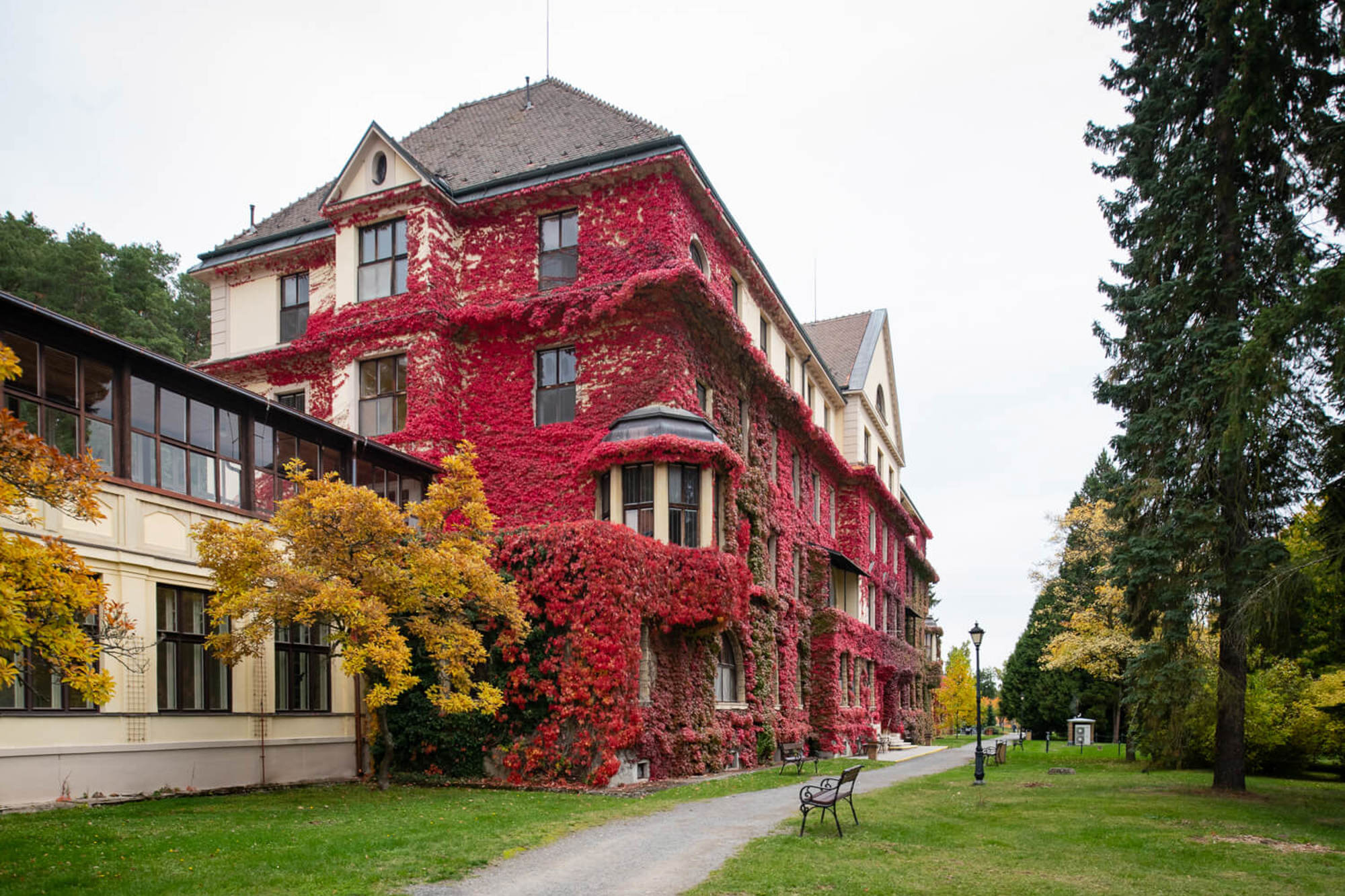
Jevíčko Sanatorium
The Mladějov Narrow-Gauge Railway and Industrial Museum
BuilThe stunning industrial grounds of the former Mladějov fireclay factory feature a narrow-gauge railway for steam locomotives, with a track extending eleven kilometers. Built towards the close of the First World War, it was intended to transport fireclay, chamotte, and local coal. The railway remained operational until the mines shut down in 1991. Steam locomotives were the primary rolling stock used on this line throughout its service history.
The Mladějov Industrial Museum is part of the complex and exhibits various examples of railway, road, agricultural, and construction equipment. All participants on the tour were impressed by the collection of historical locomotives, tractors, cars, trucks, motorcycles, and other machinery and vehicles displayed within the original historical structures. Historical costumes are also available to rent on-site.


The Hřebeč Mining Trails
An authentic “lunar landscape” has developed on the former mining paths, whose seventy-kilometer length documents the nearly two-century-old tradition of mining in this area. Brown coal and refractory clays were extracted at the Hřebeč Mine complex; today, the area is dominated by a spoil heap from the local mines..


The Renaissance Chateau of Moravská Třebová
After the rugged environment of mining, our tour transitioned to a completely different setting for its next stop - the chateau in Moravská Třebová. This chateau ranks among the most notable Renaissance monuments in Central Europe. The original castle was built in the 13th century, and modern Renaissance architectural features made their debut here in the Czech lands at the end of the 15th century.


Renaissance Great Halls (Mázhausy) and the Town Hall
In Moravská Třebová, our tour continued with visits to the burgher structures known as mázhausy (literally, “great halls” or arcaded halls), which historically functioned as the center of commercial and social life for the townsfolk. A mázhaus integrated the functions of an entry hall, a market space, and a venue for festivities and gatherings. We had the chance to view several unique, preserved Renaissance mázhausy in Moravská Třebová.
Following this, we inspected the Town Hall building, which has suffered misfortune with fires throughout its history, having been severely damaged three times in total. While the original structure dates to the 15th century, the current iteration is the result of a 1824 reconstruction.
We also visited the City Museum, whose building boasts an impressive white staircase.


The Bohuslav Tecl Observatory in Moravská Třebová
Leaving the town center, we ventured to the outskirts, ascending to the small observatory perched on Hampart Hill. It was constructed in 1975, a realization of the passion of local teacher and astronomy advocate, Boleslav Tecl. The building was briefly neglected after 1989, leading to interior damage, but operations were successfully revived in subsequent years through the efforts of amateur astronomers and volunteers. The facility is now open and features a reflector telescope and a sliding roof.


Jevíčko Sanatorium
The Jevíčko Specialist Treatment Institute was initially planned as a pulmonary clinic designated for women with tuberculosis. Construction began in 1914, and it opened temporarily as early as 1916 when the pressing need to care for the sick and wounded during World War I necessitated its use. Subsequent additions were built later, culminating in the construction of the Forest Pavilion.


Schindler’s Museum of Survivors in Brněnec
Everyone knows about Oskar Schindler, the industrialist who saved 1,200 Jews from extermination in a concentration camp. In 1944, this Moravian merchant of German descent relocated his factory from Kraków to Brněnec near Svitavy, saving his Jewish workers from certain death by moving them along with him. The Museum of Survivors opened here in 2025 to commemorate the 80th anniversary of the end of World War II.


Hotel Zlatá Hvězda (Golden Star) Litomyšl
The second day of the location tour began in Litomyšl at the Hotel Zlatá Hvězda, established in the mid-19th century. Although it has undergone numerous renovations over the years, its dominant feature today is the grand historical staircase, which originated in the Neo-Renaissance reconstruction around 1900. Some guest rooms are furnished in the Art Deco style, and a notable curiosity is a bathroom ingeniously converted from a former bank vault. In addition to accommodation, the hotel offers several private lounges with capacities ranging from 25 to 120 people.


Chateau Hill and the Litomyšl State Chateau
Just a short walk from the hotel lies Chateau Hill (Zámecké návrší), an area that groups together several historical, cultural, and social landmarks. The most significant of these are the Litomyšl State Chateau (a UNESCO World Heritage site) and the Piarist Church of the Discovery of the Holy Cross. This Baroque church features an intriguing blend of history, contemporary architecture, and modern decoration - a spacious viewing terrace was integrated between the church towers during a recent renovation. The Chateau Hill complex also incorporates the former chateau brewery and the Riding Hall.
Litomyšl Chateau, a prominent Renaissance monument, dates to the year 981. Externally, it is striking for its sgraffito façade and arcaded courtyard; internally, it houses decorated halls, period furniture, and a charming 18th-century chateau theatre - one of the few examples of its kind preserved in Europe.
Equally remarkable is the chateau kitchen, which has been preserved with great authenticity, retaining its original fittings, including stone sinks, copper cookware, and the oven. The kitchen offers a genuine 19th-century atmosphere and presents an excellent opportunity for filming historical scenes depicting daily life at the chateau


White Gallery
From Litomyšl, we visited a unique art gallery set within nature. The light and airy White Gallery building is positioned in a calm meander of the Desná stream on the edge of the village of Osík, surrounded by dense greenery. The skeletal structure, featuring large glass panes, imparts lightness and openness to the building. The gallery’s serene and balanced atmosphere actively invites visitors to take a seat, savor the view of the nature all around, and enjoy the indescribable sense of peace. The gallery is dedicated to preserving the life’s work of the painter and graphic artist Ludmila Jandová (1938–2008), who lived and created in Osík. The collection also comprises an extensive compilation of graphic prints from over 300 artists.


Primátor Camping Resort
This modern camping resort is situated off the beaten path, yet conveniently close to the center of Litomyšl. It offers twenty elegant cabins for two to eight guests, each fully equipped with a kitchenette and a bathroom. The grounds also offer pitches for tents and caravans, with an additional seven glamping tents available from May to September.


VýhledNa
VýhledNa (The Viewpoint) is an interesting architectural feat, constructed from retired shipping containers that have circumnavigated the globe several times. The design is credited to architects Miroslav Pospíšil and Martin Karlík of Atelier-r. The viewing platform is further distinguished by a lightning rod that also serves as a work of art by Olomouc sculptor Jan Dostál. This project aligns with Litomyšl’s long-standing initiative of inviting architectural studios that are top prize winners of the Czech Architecture Award competition to design elements for the municipal landscape.


Sokol Hall (Sokolovna) Dolní Sloupnice
The Modernist Sokolovna (Sokol Hall) in Sloupnice, which has been remarkably well preserved, was built in 1926 according to the plans of local architect Vojtěch Vanický, an associate of Josef Gočár. Set into a sloped site, the building stands out for the contrast between its red exposed brickwork and its light, rendered sections. Its architectural approach, which more closely resembles an industrial facility than a gym, aligned with the most advanced trends in Europe at the time. Thanks to the meticulous preservation of its details, the Sokolovna is now registered as an immovable cultural monument and is highly suitable for filming period dramas.


Max Švabinský Cottage
The former rural sanctuary of the painter Max Švabinský is a quaint dwelling situated on the edge of the village of Kozlov, nestled beneath the summit of Kozlovský Hill. The original simple cottage was expanded with a new section that included an attic room, famously called the “Trunk,” which the artist used as his studio. The house maintains a distinct rustic character, enhanced by artistic embellishments - such as the gable decorated with a scene depicting Saint Wenceslaus Receiving Gifts. The property as a whole conveys a cozy and harmonious feeling, with an atmosphere where tradition and artistic spirit converge.


This year’s final location tour provided a rich and inspirational overview of the Pardubice Region - spanning from industrial sites and Renaissance landmarks to contemporary architecture and locations with truly unique appeal. Attendees commended not only the wide variety of sites visited but also the event’s professional organization and friendly ambiance. The tour successfully reaffirmed that the region is home to a significant number of film-attractive locations capable of enhancing a diverse range of film and television productions.
Plans for next year’s location tours are already underway in collaboration with regional film offices to showcase more compelling locations throughout the Czech Republic to interested professionals.
Contact for filming in the South Bohemia Region:
South Bohemia Film Office, Hana Kabashi (kabashi@jccr.cz, +420 606 351 987)
The mission of regional film offices is to attract audiovisual projects to their regions and to be a reliable source of information for Czech producers.
One of the main tools to draw filmmakers’ attention to the region’s film-friendly locations is the location tour, which is organized for Czech film professionals, from producers and location managers to directors, writers, cinematographers, and film architects, by the regional film office in cooperation with the Czech Film Commission.
A representative of the regional film office connects filmmakers with property managers and owners. A location tour is often the first step towards further inspections for a specific audiovisual work in pre-production.
A photographer specializing in architecture, landscape, and location photography is present on the location tour. The resulting photographs are then used to promote the film-friendly locations by the regional film office and the Czech Film Commission for promotional activities aimed at foreign filmmakers and are actively offered when specific requests from abroad are received.