Featured location: A blast from the past at the Ústí House of Culture
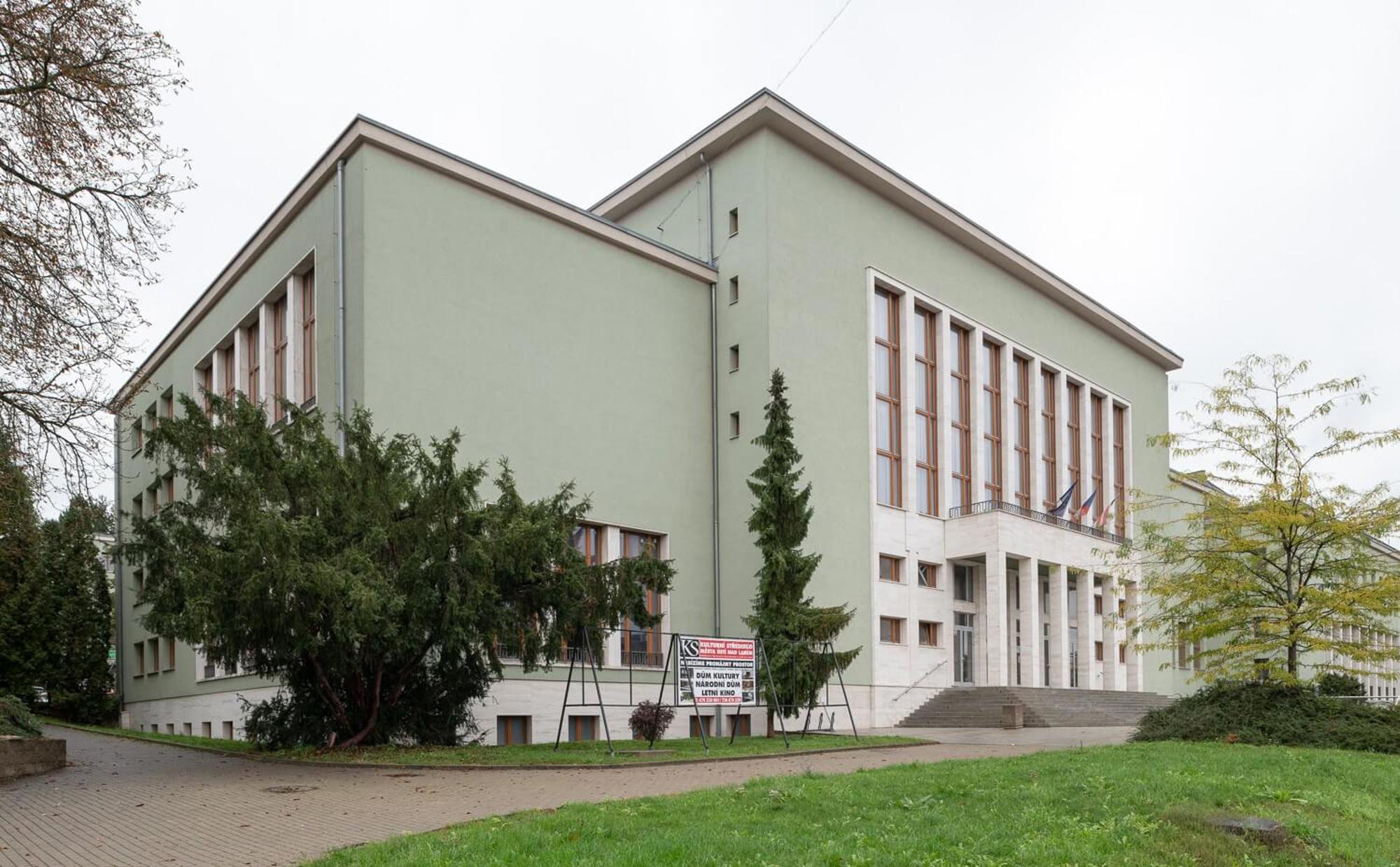
The House of Culture in Ústí nad Labem has been in operation for nearly sixty years. Its design is grandiose, as was appropriate at the time, and there are somewhat dramatic events associated with its construction. Head back with us (and the camera) to the time of political processes in the 1950s, when this monumental building was proposed, which, together with other buildings from this period, had a significant impace on the overall character of the city.
The House of Culture in Ústí nad Labem | Photo: Czech Film Commission
During the first Czechoslovak Five-Year Plan in the early 1950s, culture clubs with social halls were built in two factories in Ústí nad Labem, but neither of them had sufficient capacity. The Revolutionary Trade Union Movement set itself the task of expanding the living and cultural standards of the workers, and planning began for the construction of a new Trade Union House of Workers’ Culture.
In 1954, they chose the site of the grandiose Neo-Gothic Schaffner Villa as the location for the House of Culture. Dating to the end of the 19th century, the villa originally belonged to the director of the Ústí nad Labem chemical factory and housed city officials during World War II. In September 1959, the magnificent “capitalist” villa was demolished, and construction began on a building in an entirely different style: socialist realism. The term “socialist realism” was approved in 1932 by the Central Committee of the Communist Party of the Soviet Union as the official directive for literature, fine arts and music.
The House of Culture was constructed hastily, but its opening had to be delayed in the end. The workers laid the parquet in the large hall too soon. It soaked up the moisture from the freshly built walls and concrete floors, stretched and bulged in the middle of the room to a height of almost two meters, after which the floor began to tear down the walls. The frightened guard called one of the engineers in the middle of the night, and together with the help of a pickaxe, they quickly pulled up two rows of parquet from around the perimeter of the room. The House of Culture was ceremoniously opened after repairs in May 1964.
Czech Film Commission
Czech Film Commission
The House of Culture comprises a theater hall, a lecture room, a puppet stage, a number of classrooms, and a restaurant. Here you will find the unique preserved interiors of the cinema hall with a capacity of 624 seats, the entrance hall, which serves as a period cloakroom, and a dance hall with a capacity of 900 seats with preserved original decor and lighting. About ten years ago, part of the House of Culture was renovated and is now home to the Children and Youth Center.
At the House of Culture, they are very accommodating to filmmakers. They offer spaces not only for filming, but also for filming facilities inside the building and parking both in front of and behind the main building. Electrical connections, lighting and water are all available. Marcela Bořutová is in charge of renting the premises: "It makes us happy that the House of Culture is also used for film purposes. Thanks to cooperation with the Ústí Region Film Office, dozens of filmmakers from the Czech Republic and and abroad have already been scouting here, and several film crews have already shot here. We are used to working with filmmakers and we’d be delighted to offer facilities for filming elsewhere in the city center as well."
Barbora Hyšková from the Ústí Region Film Office warmly recommends the House of Culture to filmmakers: “The House of Culture is one of the most film-friendly locations in the Ústí Region. They are extremely accommodating and open to collaboration with filmmakers. Recently, for example, the film Palach, directed by Robert Sedláček, was shot here, and the crew of Czech Television's series Rapl IIwith director Jan Pachl also used the House of Culture as a location."
The House of Culture is located in the very center of Ústí nad Labem and nearby you’ll find a number of other social realist buildings, including, for example, the National House and the Slovanka restaurant.
In order to give you the best service, we need your consent.
We use cookies. They help our website work properly so you can quickly find what you are looking for and so we will not bother you with advertising from third-party websites that does not interest you. Your consent helps us keep the website in a familiar format and make further improvements to it.
Custom cookie settings
Cookies that are necessary
for the website to work at all
These cookies ensure that the website works correctly and safely. Necessary cookies are automatically saved in your browser.
Statistical and analytical cookies
help us know what to improve.
With your consent, we can use third-party utilities like Google Analytics, which help us gather feedback and improve our website. You need not worry about your privacy. We monitor anonymised data on the amount of traffic on our website, the average length of a visit, or what parts of the website users are clicking on.
Cookie types
_ga
Registers a unique ID that is used to create statistical data about how the visitor uses the website.
Typ: HTTP | Za kolik dní vyprší: 369
More about cookies
Cookies are small data files that are used to make your experience of using our website more pleasant and are temporarily stored in your browser.
According to the law, we can only store cookies that are necessary for the proper operation of the website without your consent. We need your permission for all other types of cookies.
You can change or cancel your consent and cookie settings at any time via the Cookie settings link in the footer of the website.
Chaoyang is a bustling district located in the heart of Beijing, China. It is known for its modern
architecture, thriving business district, and vibrant nightlife. The area is home to many high-end
shopping malls, luxury hotels, and fine dining restaurants, as well as cultural landmarks such as the
China Red Sandalwood Museum and the Chaoyang Park. With its convenient location and easy access to
public transportation, Chaoyang is a popular destination for both tourists and business travelers alike.
If you're looking for a lively and cosmopolitan experience in China, Chaoyang is definitely worth a
visit.