10. September 2017

“The Louka Abbey complex is likely the most extensive Romanesque building of its type in the world. It comprises not only the monumental Premonstratensian abbey and its vast cellars, but also the Church of the Virgin Mary and St. Wenceslas with its original Romanesque crypt. The spacious grassy area inside the abbey can be used as an attractive backdrop, or as parking for the crew," explained Ivana Košuličová of the Brno Film Office.
The abbey is located on the southern side of Znojmo on the left bank of the Thaya (Dyje) River, which forms a natural boundary on the western side of the complex. To the south, it neighbors a new swimming pool; to the east, its property extends nearly to Dukelska Street (the I/38 road); and to the north, it is bordered by an access road and public greenery.
The Znovín Znojmo winery currently uses part of Louka Abbey as its company seat and occasionally organizes events for the public. At present, however, only about 1/25th of the entire complex is utilized - the rest remains empty.
"In the near future, the entire property will undergo a costly and time-consuming renovation. Before this takes place, however, we'd like to offer it for filming. The interiors can be adapted to the specific needs of the production. To date, only the former riding school has been renovated and is now used for cultural and social purposes. The windows on part of the south facade of the south wing of the abbey have been replaced with handmade replicas that fully replicate the appearance of the original historical windows,” says Košuličová.
“The abbey complex has served as a film location in the past. Filmmakers used the original Romanesque crypt in the TV film Santiniho jazyk and in the series Ďáblova lest and Labyrint,” adds Košuličová.


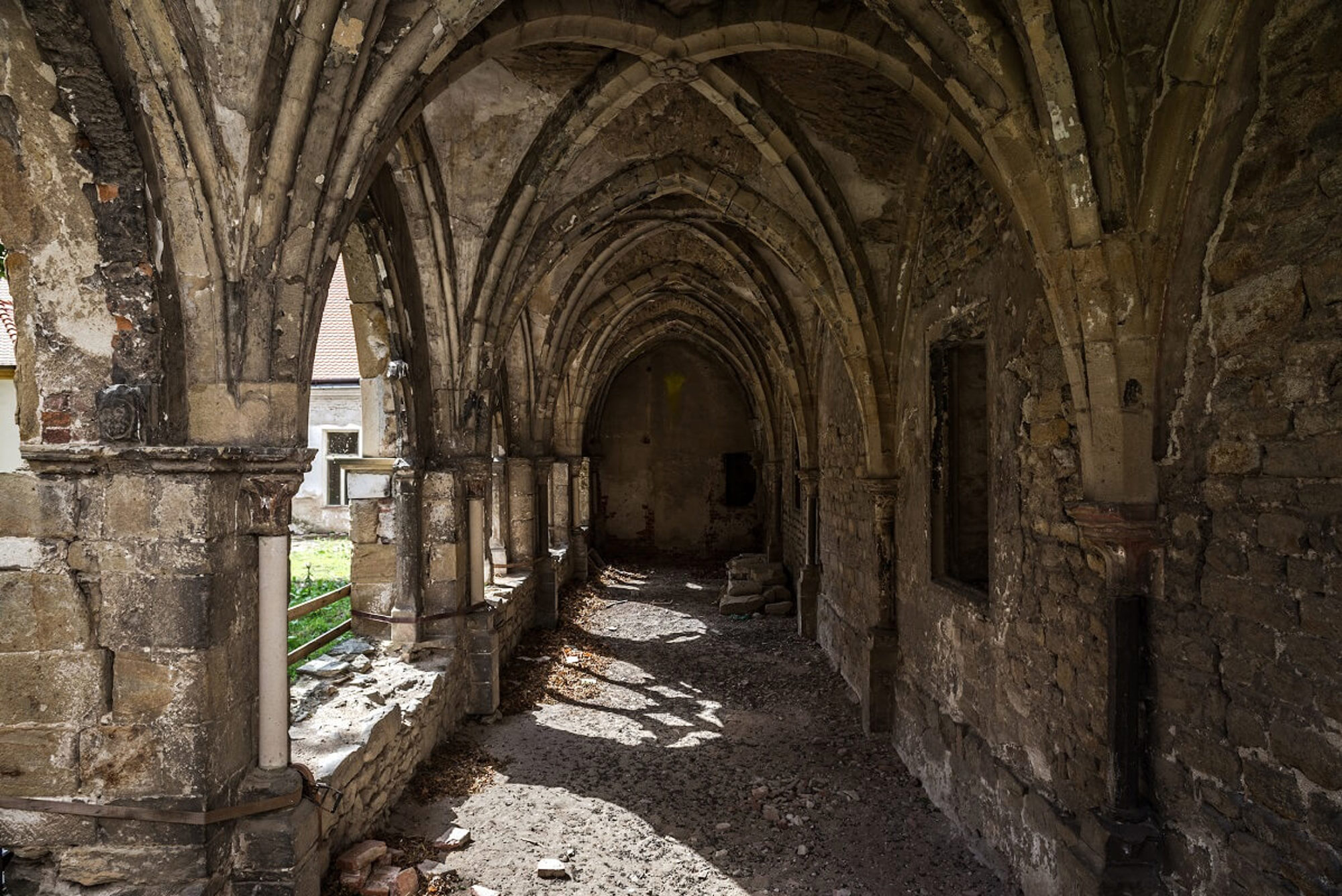
Over the centuries, the complex has undergone elaborate architectural development. The oldest – late Romanesque – stone appearance of the abbey has been preserved in fragments of the early Gothic gallery of the cloister as well as in the unique Romanesque crypts under the Church of the Virgin Mary and St. Wenceslas.
It was the High Baroque, however, that made the most lasting impression on the abbey: in 1748, it started with the monumental, costly construction of the convent based on the biblical Solomon’s Temple. The most impressive space is the library located in the south wing – the world-famous library at Strahov Monastery in Prague is a faithful copy.
In 1784, Emperor Joseph II closed the abbey, and the Baroque structure remained two-thirds unfinished. The Baroque convent’s massive spaces were used throughout the 19th and 20th centuries as a military barracks.
For more information, please contact Ivana Košuličová from the Brno Film Office at kosulicova@ticbrno.cz, +420 773 771 556, or Ing. arch. Iveta Ludvíková, City of Znojmo at iveta.ludvikova@muznojmo.cz, +420 739 389 044.